Way back in June—almost 5 months before the voting took place—I made a prediction about the outcome of the mayoral race in Minneapolis. Specifically, I predicted that the winner of the election would not get 50% of the votes cast. For this, I was told, among other things, that I didn't understand how ranked choice voting works, and that I was a troll. I was also right.
As you can see on the election results page, Betsy Hodges was elected the new mayor of Minneapolis with 48.95% of the votes cast. Close, but not quite, 50%. (And I'll argue below that she actually got a slightly lower percentage than that.) I should point out that I know absolutely nothing about Minneapolis politics; I've never even ever set foot anywhere in Minnesota. All I knew was that RCV was going to be used and that the DFL failed to choose an endorsement for the race, so there would be 6 DFLeres along with 29 other candidates on the ballot.
The Stakes
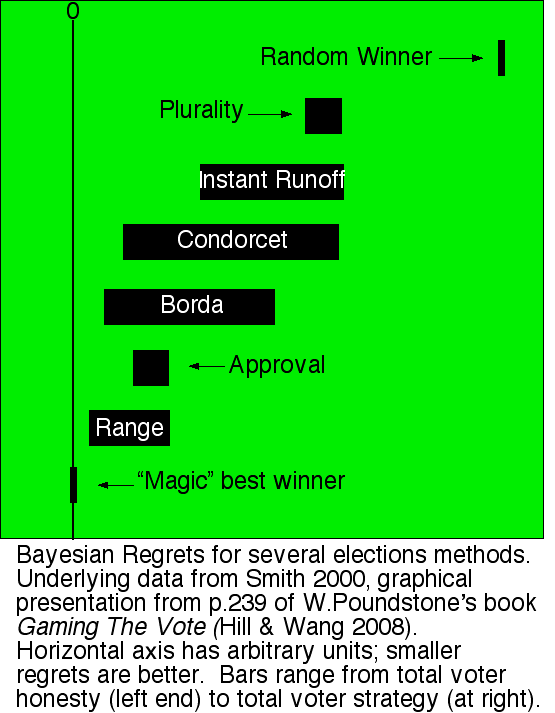
It's not actually important that RCV is able to elect a winner with less than 50% support. What's important is maximizing expected voter satisfaction, and RCV (AKA "Instant Runoff") is not particularly good at that. But plurality is terrible, so a lot of people are looking for something to replace it with, and they have been plied with stories from certain less-than-reliable organizations that RCV "upholds majority rule"—along with other, less-easily-falsifiable claims. And it's the easy falsifiability that makes this important... or at least useful. Since RCV is a poor target for reform, my hope is that disproving one of it's selling points will get activist to take a closer look, and discover the superior (single-winner) election method reform choices of approval and score voting.
Side Bet
But the mayoral winning percentage wasn't the only prediction I'd made about the Minneapolis election results. I'd also claimed that there would be more spoiled ballots in this election than there had been in the 2005 election (the last one before RCV.) But what I didn't know (remember: I know nothing about Minneapolis) was that the city had invested in new machines to immediately check ballots, and give voters the chance to try again if they made a ballot-invalidating error. And it worked really well! Almost all voters successfully cast a valid ballot, so Kudos to Minneapolis. But with this new check, we're no longer comparing apples to apples. Luckily, the Municipal Canvassing Board still accounts for spoiled ballots, and their report provides the number we need to make a fair comparison. Recall that the ballot spoilage rate in 2005 was a hair over 1.0%. According to this year's report, there were 3,358 spoiled ballots, and 80,099 ballots cast (note: I'm not sure where the two ballot difference between the report and the results webpage comes from.) That works out to just under 4.2%, closely matching the 2009 results and, again, more than quadrupling the pre-RCV rate.
There's been more than a little bit of confusion—some of it caused intentionally—about RCV's effect on ballot spoilage rates in Minneapolis, so this is another RCV-advocate claim whose falsehood I find is important to point out.
Odds (and Ends)
I downloaded the full mayoral election results spreadsheet to play around with, but it turns out that, despite all the ink spent on it, this was a really boring and, honestly, kind of predictable race. But if you're curious, here are a few other numbers I pulled out:
- Total Ballots: 80,101
- Non-Blank Ballots in Mayoral Race: 79,462
- Valid Ballots in Mayoral Race: 79,415
That means there were 47 voters who tried to vote in mayoral race, but who weren't counted because, in each rank, they either undervoted (listed no choice) or overvoted (listed more than one choice). And these 47 voters are separate from the 639 voters who voted on something in this election but who completely skipped the mayoral race (i.e., undervoted in all three ranks.) This is why I think Hodges actual winning percentage should be reported as 48.92%, instead of 48.95%: Those 47 voters deserve to be counted towards achieving a majority.
- Valid Ballots with an Overvote in Mayoral Race: 142
- Valid Ballots with a Skipped Rank in Mayoral Race: 292
- Valid Ballots with Duplicated Candidates in Mayoral Race: 11,673
These groups of ballots were all counted toward the majority by the official count, since they had at least some valid information. However, they also illustrate a lack of understanding by the electorate for how RCV actually works. Skipping a rank (i.e., filling in only ranks 1 and 3, or 2 and 3) or duplicating a candidate in multiple ranks, can't change the outcome, but apparently over 15% of voters think it might; that's not a good sign. The overvotes are even more concerning, since they could theoretically change the outcome (and should have all been caught by the fancy new scanners.) Thankfully, they were rather few (probably because of the fancy new scanners.)
Showdown
This makes two consecutive elections where RCV didn't screw up, at least not on the same scale as it did in Burlington, VT. On the one hand, that's good for the people of Minneapolis. On the other, since RCV is not an overall good election reform, it's probably bad, since it means there isn't going to be a strong motivation to change away from the system before people get accustomed to it... unless someone takes this "less than 50%" outcome, and all the other arguments against RCV, and runs with it. Minneapolitans (I had to look that up!) let me know if I can help.


