Showing posts with label minneapolis. Show all posts

Saturday, November 30, 2013

Minneapolis Results

Way back in June—almost 5 months before the voting took place—I made a prediction about the outcome of the mayoral race in Minneapolis. Specifically, I predicted that the winner of the election would not get 50% of the votes cast. For this, I was told, among other things, that I didn't understand how ranked choice voting works, and that I was a troll. I was also right.

As you can see on the election results page, Betsy Hodges was elected the new mayor of Minneapolis with 48.95% of the votes cast. Close, but not quite, 50%. (And I'll argue below that she actually got a slightly lower percentage than that.) I should point out that I know absolutely nothing about Minneapolis politics; I've never even ever set foot anywhere in Minnesota. All I knew was that RCV was going to be used and that the DFL failed to choose an endorsement for the race, so there would be 6 DFLeres along with 29 other candidates on the ballot.
The Stakes

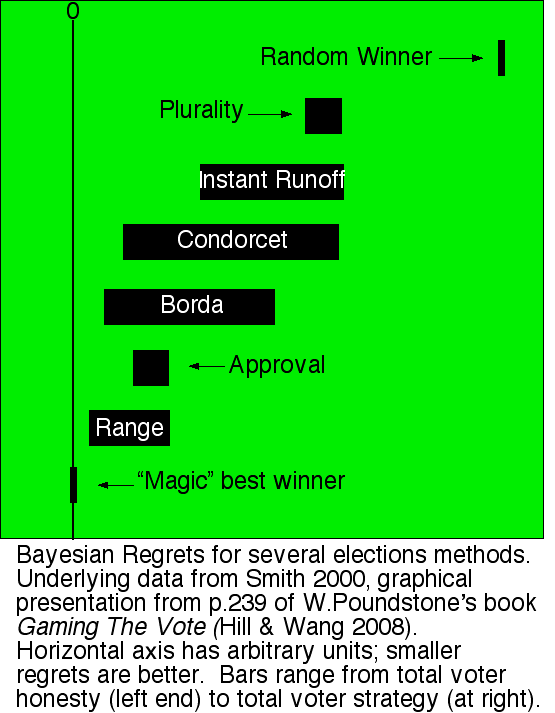
It's not actually important that RCV is able to elect a winner with less than 50% support. What's important is maximizing expected voter satisfaction, and RCV (AKA "Instant Runoff") is not particularly good at that. But plurality is terrible, so a lot of people are looking for something to replace it with, and they have been plied with stories from certain less-than-reliable organizations that RCV "upholds majority rule"—along with other, less-easily-falsifiable claims. And it's the easy falsifiability that makes this important... or at least useful. Since RCV is a poor target for reform, my hope is that disproving one of it's selling points will get activist to take a closer look, and discover the superior (single-winner) election method reform choices of approval and score voting.

Side Bet

But the mayoral winning percentage wasn't the only prediction I'd made about the Minneapolis election results. I'd also claimed that there would be more spoiled ballots in this election than there had been in the 2005 election (the last one before RCV.) But what I didn't know (remember: I know nothing about Minneapolis) was that the city had invested in new machines to immediately check ballots, and give voters the chance to try again if they made a ballot-invalidating error. And it worked really well! Almost all voters successfully cast a valid ballot, so Kudos to Minneapolis. But with this new check, we're no longer comparing apples to apples. Luckily, the Municipal Canvassing Board still accounts for spoiled ballots, and their report provides the number we need to make a fair comparison. Recall that the ballot spoilage rate in 2005 was a hair over 1.0%. According to this year's report, there were 3,358 spoiled ballots, and 80,099 ballots cast (note: I'm not sure where the two ballot difference between the report and the results webpage comes from.) That works out to just under 4.2%, closely matching the 2009 results and, again, more than quadrupling the pre-RCV rate.

There's been more than a little bit of confusionsome of it caused intentionally—about RCV's effect on ballot spoilage rates in Minneapolis, so this is another RCV-advocate claim whose falsehood I find is important to point out.

Odds (and Ends)

I downloaded the full mayoral election results spreadsheet to play around with, but it turns out that, despite all the ink spent on it, this was a really boring and, honestly, kind of predictable race. But if you're curious, here are a few other numbers I pulled out:

  • Total Ballots: 80,101
  • Non-Blank Ballots in Mayoral Race: 79,462
  • Valid Ballots in Mayoral Race: 79,415

That means there were 47 voters who tried to vote in mayoral race, but who weren't counted because, in each rank, they either undervoted (listed no choice) or overvoted (listed more than one choice). And these 47 voters are separate from the 639 voters who voted on something in this election but who completely skipped the mayoral race (i.e., undervoted in all three ranks.) This is why I think Hodges actual winning percentage should be reported as 48.92%, instead of 48.95%: Those 47 voters deserve to be counted towards achieving a majority.

  • Valid Ballots with an Overvote in Mayoral Race: 142
  • Valid Ballots with a Skipped Rank in Mayoral Race: 292
  • Valid Ballots with Duplicated Candidates in Mayoral Race: 11,673

These groups of ballots were all counted toward the majority by the official count, since they had at least some valid information. However, they also illustrate a lack of understanding by the electorate for how RCV actually works. Skipping a rank (i.e., filling in only ranks 1 and 3, or 2 and 3) or duplicating a candidate in multiple ranks, can't change the outcome, but apparently over 15% of voters think it might; that's not a good sign. The overvotes are even more concerning, since they could theoretically change the outcome (and should have all been caught by the fancy new scanners.) Thankfully, they were rather few (probably because of the fancy new scanners.)

Showdown

This makes two consecutive elections where RCV didn't screw up, at least not on the same scale as it did in Burlington, VT. On the one hand, that's good for the people of Minneapolis. On the other, since RCV is not an overall good election reform, it's probably bad, since it means there isn't going to be a strong motivation to change away from the system before people get accustomed to it... unless someone takes this "less than 50%" outcome, and all the other arguments against RCV, and runs with it. Minneapolitans (I had to look that up!) let me know if I can help.

Tuesday, October 22, 2013

October Op-Eds Weave RCV Spell over Minneapolis

Minneapolis is conducting their local elections by ranked choice voting (AKA instant runoff voting) for the second time this November. I've already written about this a number of times. But with the election drawing closer, RCV proponents are getting op-eds published in an attempt to hype the systems purported advantages.

Please indulge me while I reiterate my refutations of these common, and false, RCV talking points.

  • RCV does not "ensure majority outcomes": With the large number of candidates running for mayor, and the inability of the Democratic-Farmer-Labor party to settle on an endorsement, there is an extremely high likelihood that the winner of that election will not have a majority of the votes cast, since a large number of votes will be exhausted. But be on the lookout, because reported results will likely conceal the total number of ballots cast, as they did in the 2010 Oakland mayoral election, giving only the number of "continuing ballots" in the final round.
  • RCV does not "encourage more respectful campaigns": We know this because of experience in California. It does seems that the first couple RCV elections are more respectful, but this is solely because of RCV advocates' claiming this to be true, and uncertain politicians being afraid that they might be right. But after having some experience with the new system, trying some negative ads, and seeing the effect on their polling, the politicians realize they've been tricked, and go back to their old ways.
  • RCV does not eliminate "fear of a wasted vote": This is the most persistent RCV myth, because it appears true at first glance. And it is true... when there are only two significant candidates. Since most elections have only two significant candidates, it can take quite some time for the truth to come out. But we only need to look at Burlington, VT to remind ourselves. It's unclear if we'll see it in Minneapolis this year though. I give it about 1-in-5 odds of occurring.

I do agree with the op-ed authors that this is perhaps the most important test of RCV yet. And I've already made one testable prediction about the outcome of these races: That the mayoral race winner will not win a majority of the votes cast. And now, I'd like to add a second testable prediction, one for which I have even higher confidence: There will be a higher percentage of spoiled ballots for this election than there were in the 2005 election (the last one before the change to RCV). This op-ed didn't repeat the claim, but previous ones had implied (falsely) there was only one spoiled ballot in the 2009 election. The actual rate was over 4.1%, while the 2005 rate was less than 1.1%. I expect similar performance this year.

Those are my claims. If any RCV proponent would like to make a friendly wager of it, you can step up in the comments.

Wednesday, June 26, 2013

Red Crayon Statistics

I know, I implied the previous post would be the last one about Minneapolis. But I can't help it. My first post on the subject implied that former interim elections official Patrick O'Connor was lying about the 2009 ranked-choice-voting-powered election in Minneapolis, as the official report (which he commissioned) contradicts his claims. But today, the exact same lie is being propagated by the author of the report!

I started to question my own sanity here. These guys really should know better, and no one could really expect to get away with such an obvious lie. Is it possible I'm the one who's wrong? But then I remembered how absolutely ludicrous it is to suggest that only one ballot out of nearly 50,000 could be spoiled. No system has ever been that accurate, and anything under 1% is considered a triumph of electoral vigilance.

But then I noticed the subtlety they're using here. Both O'Connor and Schulze talk about spoiled ballots earlier in their articles, but when they try to counter the complaints of excessive ballot spoilage under RCV, their specific claim is that only one ballot was "uncounted". Now, given the context of that claim, you might assume that "uncounted" and "spoiled" are being used as synonyms for each other. Nope! Let's check the report again!

Of the 45,968 total ballots cast, there were 1,888 spoiled ballots and 2,958 voter error ballots (2009 Election Statistics, n.d.), which indicates ballots with voter errors specific to Ranked Choice Voting, including overvote, repeat candidate, skipped ranking and undervote (Minneapolis Method for Hand-Counting RCV Ballot Sorter & Counter, n.d.). Comparatively, during the general municipal election in 2005, there were 755 spoiled ballots of the total 70,987 absentee and in-person voters (Voter Turnout and Registration, 2005). In 2009, there was only one ballot cast that was totally defective and not counted. This was a ballot where no ovals were filled in and a handwritten essay written in red crayon on it. Excluded from this analysis are any ballots not counted due to failure to comply with the rules regarding absentee ballots. These ballots were not opened to ascertain voter intent.
That is the "one ballot" they're talking about. There were 1,888 spoiled ballots, a more than 380% increase in spoilage rate over the previous election, but never mind that! Because only one guy wrote on their ballot in crayon that year, that means those 1,888 don't really count against anything.

The truth is, RCV nearly quadrupled the number of spoiled ballots in Minneapolis, and there would have been a ten-fold increase had the election been machine-counted rather than hand-counted. That alone aught to be enough to disqualify RCV as an election method, but there are plenty of other reasons for it, too.

I'm upgrading O'Connor's and Schulze's "damned lie" to "statistic".

Tuesday, June 18, 2013

Minneapolis Prediction

One more thing about Minneapolis: apparently, despite multiple ballots, the Democratic-Farmer-Labor party wasn't able to decide on an endorsement among the six candidates interested in running for mayor under its party label. So all six will appear on the "choose three" ranked choice ballot, along with four other candidates. This makes it very likely, like in Oakland before, that the winner of this vote will not end up with more than 50% of the ballots cast, despite the claims of ranked choice supporters that it guarantees a majority win.

The way this happens is that many ballots will have all of their listed candidates eliminated, at which point the ballot is no longer considered to count towards determining a majority. This occurred for about 11% of the ballots in Oakland, except the final results weren't reported as "45%/44% with 11% exhausted", they were reported as "51%/49%". In other words, the final results were reported as if 13,000 voters didn't exist.

We'll see what happens, and how it's reported, in Minneapolis this November, but my money is on a similar outcome.

Tuesday, June 11, 2013

In Minneapolis, Someone's Not Being Truthful

UPDATE: I've figured out where O'Connor is getting his number from.

Way back in 2010, I wrote a post about the final, official, report for Minneapolis' inaugural Ranked Choice Vote, conducted in 2009. It was an entirely boring election with entirely predictable results, and RCV did no worse or better than any other election method would in such a situation. The most-damning part of the report though, was how RCV seemed to have caused a quadrupling in the percentage of spoiled ballots, from 1.06% to 4.1% (see page 18 of the report.)

So imagine my surprise when I see in my RSS feed an OpEd from the Minneapolis StarTribune claiming that only one single ballot was spoiled. And imagine my further surprise when I see that it was penned by Patrick O'Connor, Minneapolis' interim elections director during that 2009 election, the same Patrick O'Connor mentioned by name (on page 1) of the very report that so grandiosely contradicts his statements published today.

Did Mr. O'Connor simply not read the report he commissioned four years ago? Or is he intentionally spreading falsehoods about it? I think Minneapolis deserves to know.

Monday, August 16, 2010

Further Thoughts: Minneapolis RCV Report

I was contacted via email by a concerned reader about my last post, discussing Minneapolis' use of ranked choice voting (RCV, AKA instant runoff voting (IRV)). This reader had attempted to contact the report's lead author, Dr. David Schultz, with the hope of clarifying a few points, such as:

  • The paper notes a factor of four increase in ballot spoilage rates, but the prose refuses to acknowledge the possibility that any of this increase was due to the use of RCV. What else would Schultz attribute the increase to?
  • How is such a large number of votes being tossed out not disenfranchisement? How would Schultz identify disenfranchisement?
  • How does Schultz reconcile the 7.5% ballot-error rate with a claim that there did not seem to be any voter confusion?

Unfortunately, Dr. Schultz chose not to answer any of these salient points at all, and was rather short--I would say insultingly dismissive, if the message forwarded to me is any indication--with the few questions he did answer. (One question, about why Schultz's report made constant comparisons to first-past-the-post while Minneapolis had previously used top-two-runoff, was answered with "SO? Your point?")

So perhaps I was too generous to the good doctor. It seems he desperately wants to "prove" that RCV/IRV works, and despite reporting the numbers truthfully (which, he should be praised for), it seems he will continue to support pro-IRV rhetoric, even when his own numbers strongly suggest against it; and that he isn't interested in discussing it.

Tuesday, July 27, 2010

Minneapolis RCV Report: IRV Is No Magic Bullet

Dr. David Schultz (not be confused with Mark Schulze, of Schulze method fame) has posted his report for the Minneapolis Elections Department on the use of ranked choice voting [PDF] (more commonly known as instant runoff voting or IRV), as it was used in that city's recent elections. Schultz was (and apparently still is) a strong supporter of the use of IRV, having previously served as a board member for FairVote Minnesota, a fact he plainly states in his paper's Conflict of Interest heading. And this refreshing honesty continues throughout the document... which probably isn't good news for FairVote's or Dr. Schultz's objectives.

First on the chopping block is the claim that IRV increases turnout. Turnout for the 2009 IRV election was down 21% form the 2005 election. Now, there are many reasons for turnout to vary between elections--for instance, the report mentions that there weren't any particularly heated contests on the ballot--so this alone isn't certainly damning for IRV; but it surely doesn't help.

We also find that the well-advertised claim of decreased election costs turned out to not be true. We already knew this, based on a previous report, but it's worth reiterating: even when one-time costs, including voter-education costs, are ignored, the 2009 IRV election cost 20% more than the 2005 election. This is primarily a labor-cost issue, since Minneapolis was not able to find any voting machines capable of adjudicating an IRV election which meet the necessary security and accountability requirements set by law; so the vote had to be counted by hand. Schultz hopes that, perhaps, other towns in Minnesota will express interest in IRV, which will encourage the approval of the cost-saving IRV-capable voting machines. Considering the continuing problems of Diebold Premier Dominion Voting, I wouldn't hold my breath.

I do have one serious complaint about this report, and that's Schultz's claim that first past the post (FPTP, AKA plurality voting) is, like IRV, non-monotonic. This statement is unequivocally false, and the blatant attempt to whitewash this shortcoming of IRV stands out, painfully, against the otherwise honest assessments given throughout.

But my "favorite" part of the report is the section on Spoiled Ballots and Voter Error. Schultz begins by assuring us that "[T]he worst fears were not realized." By which he means IRV only quadrupled the ballot-spoilage rate, from 1.0% to 4.1%. It's true, previous IRV elections would suggest a six- or seven-fold increase in spoilage rates would be expected. Although it should be pointed out that, in addition to the 4.1% of ballots that had to be thrown out, an additional 6.4% had "errors" which the hand-counting procedure was able to "ascertain the intent of," for a total error rate of 10.5%. It's not clear how these ballots would have been handled by an automated system, had one been available.

Finally: how much of an impact did IRV have on the election? In all 20 single-winner contests, the candidate with the most initial 1st-place votes won the election. In 17 of these 20, the winner surpassed the 50% threshold immediately, and in the other 3 cases they did so after the first round of eliminations. But I don't want to hold this too strongly against IRV: as mentioned earlier, there weren't any hotly-contested races in this election. That usually means low-turnout and a lot of blow-out elections. Realistically, any electoral system would probably have come to the same conclusions in these races as IRV did. The true measure of an electoral system's quality is how well it can handle highly-contested and close-to-call elections. The predominant examples suggests that IRV would handle such elections poorly; but the Minneapolis data provides no real information for or against that proposition.

I hope that Dr. Schultz will carefully consider the empirical data that his report has highlighted, and that it will help to temper the misleading rhetoric that FairVote Minnesota has used, and which the national FairVote organization continues to use, to push for IRV's adoption around the country.